Full-Arch Reconstruction at Wise Dental Solutions
Full-arch reconstruction is not a single procedure. It's a category of treatment — and within that category, there are meaningful differences in surgical approach, prosthetic design, timeline, and long-term outcome.
If you've been researching your options online and feel more confused now than when you started, that's normal. The internet is full of competing brand names, aggressive pricing claims, and simplified promises. The reality is more nuanced — and in most cases, more encouraging than what you've read.
What Is Full-Arch Reconstruction?
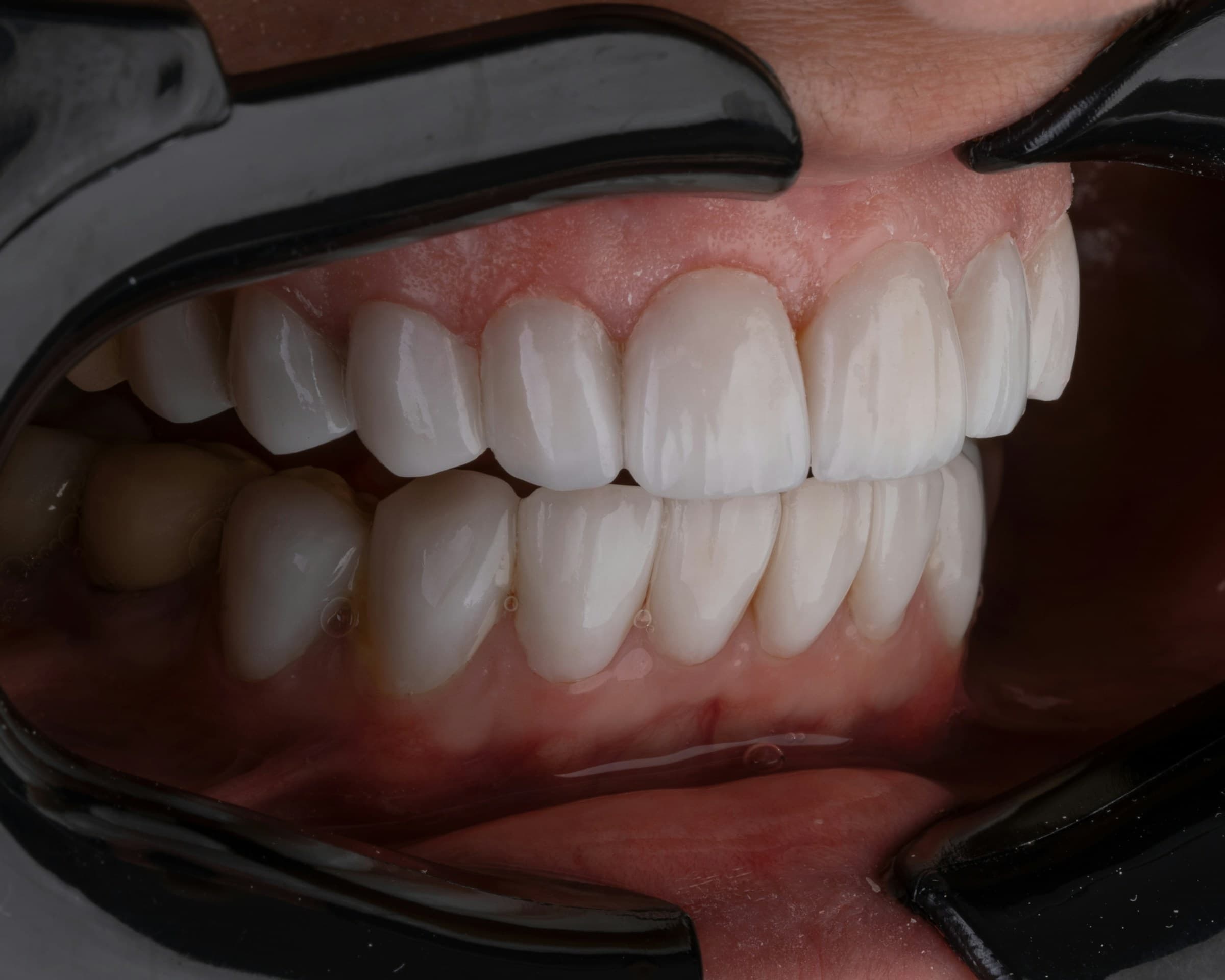
Full-arch reconstruction replaces an entire arch of teeth — upper, lower, or both — with a fixed, implant-supported prosthesis. Unlike removable dentures, a full-arch restoration is permanently anchored to the jaw. It doesn't come out. It doesn't shift or float. It functions and is cared for similarly to natural teeth.
Four to eight implants are typically placed in each arch, depending on anatomy, prosthetic design, and bone availability. Those implants integrate with the jawbone and serve as the structural foundation for the final prosthesis.
“The most successful cases are individualized. One of the biggest misconceptions online is that every patient should receive the exact same implant protocol.”
— Dr. Micah Weisenberg
The FP1 / FP2 / FP3 Framework
Every full-arch case at Wise Dental Solutions is evaluated using the FP classification system — a clinical framework that categorizes restorations by how much tissue replacement the prosthesis provides.
FP1 produces the most natural-looking result, with the prosthesis emerging from a natural gumline — but requires adequate bone and tissue to support it. FP3 compensates for greater bone and tissue loss using a pink gingival flange, and is often the most appropriate and predictable option for patients with significant atrophy. FP2 falls between the two.
Most heavily marketed “All-on-4” procedures produce an FP3 result. That's clinically appropriate for many patients. But not every patient is an FP3 candidate by default — and that determination should be made based on anatomy, not on what's simplest for the practice.
Surgical Approaches
Traditional Full-Arch Placement
Implants are placed in optimal positions based on bone availability and prosthetic requirements. Pre-surgical digital planning guides implant position, angle, depth, and spacing before the procedure begins.
Angled Implant Placement (All-on-X Style)
In cases where bone density or volume in the posterior jaw is limited, implants may be placed at an angle to engage denser bone further forward. This reduces or eliminates the need for sinus augmentation in some cases while maintaining stability.
Segmental Full-Arch (3-on-6 Style)
Dr. Weisenberg also performs segmental full-arch reconstruction — sometimes referred to as 3-on-6 style — using three prosthetic segments supported by six or more implants. This approach offers advantages in certain situations, including improved hygiene access, a more segmented and natural appearance, and easier repair if one segment needs attention later. It requires advanced surgical and restorative planning and is not offered at most implant practices.
What to Expect: The Full-Arch Timeline
Consultation and Diagnostics
Your first appointment is focused on understanding — your concerns, your history, and your anatomy. We'll review a CBCT scan, digital impressions, and photographs together so you can see exactly what we're seeing. By the end of your consultation, you'll have a clear picture of your options, your timeline, and what the investment looks like.
Digital Treatment Planning
Every case is planned digitally before surgery begins. This means your implant positions, angles, and depths are determined in advance using your scan data. Digital planning improves precision, reduces surgical time, and allows us to show you what the outcome will look like before any procedure takes place.
Surgery Day
Most patients are surprised by how organized and calm the process feels. Because every step is planned in advance, surgery is structured and predictable. You'll go home the same day with a transitional prosthesis in place — the beginning of your new smile.
Healing and Tissue Optimization
The healing phase is one of the most important parts of the process. We monitor implant integration, tissue response, and bite function carefully. This phase typically includes a second set of provisional teeth — designed around how you speak, chew, and smile — before we move to the final restoration. We don't rush this step.
Final Restoration
The final prosthesis is designed not just for esthetics, but for speech, chewing function, cleanability, comfort, and long-term maintainability. Materials are selected based on what will serve you best over a 10-to-20-year horizon.
Long-Term Maintenance
Full-arch implant restorations require ongoing monitoring. We continue watching tissue health, bite forces, hygiene access, and prosthetic stability over time. Implants are not "set it and forget it" — and the practices that treat them that way tend to produce the revision cases we see years later.
Financing Your Treatment
Wise Dental Solutions offers financing through Proceed Finance and Cherry, with additional in-house membership options in development. We're out-of-network for most insurance plans but assist patients with reimbursement documentation.
We'll walk through the financial side during your consultation so you have a complete picture before making any decisions.